
Across Aboriginal Australia, drums are less about loud spectacle and more about holding rhythm, time and connection with Country. While many people first think of the yidaki or didgeridoo when they imagine Aboriginal music, a quieter world of hand drums, clapsticks and skin-headed instruments supports song, dance and ceremony in many regions.
Rhythm, Country and Ceremony
In Aboriginal cultures, music is inseparable from land, kinship and ancestral stories. Drumming and percussion help carry songlines, which are pathways of story and law that map the land and the sky. A steady beat keeps dancers in step, signals changes in the narrative and marks the presence of specific ancestral beings, rather than existing as entertainment on its own.
In some communities, the sound of a drum or set of clapsticks is understood as a voice for Country itself. The pulse can echo hoofbeats of creator beings, the roll of distant thunder or the sound of feet travelling through an ancestral landscape. When the rhythm begins, it is an invitation for spirits, elders and participants to gather in the same space and time.
Types of Aboriginal Drums and Percussion
Aboriginal musical traditions are diverse, so the instruments used vary from region to region. Some groups use hollowed logs or wooden frames covered with skins, while others rely more heavily on clapsticks and body percussion. Skin-headed drums are more prominent in northern and central parts of the continent, where animal hides and specific timbers are well suited to drum making.
Clapsticks, called by many local names, are among the most widespread rhythm instruments. Players strike two pieces of hardwood together to create a sharp, clear beat that can cut across open air during outdoor gatherings. In some traditions, the person who holds the clapsticks also carries special authority as a song leader or custodian of particular stories.
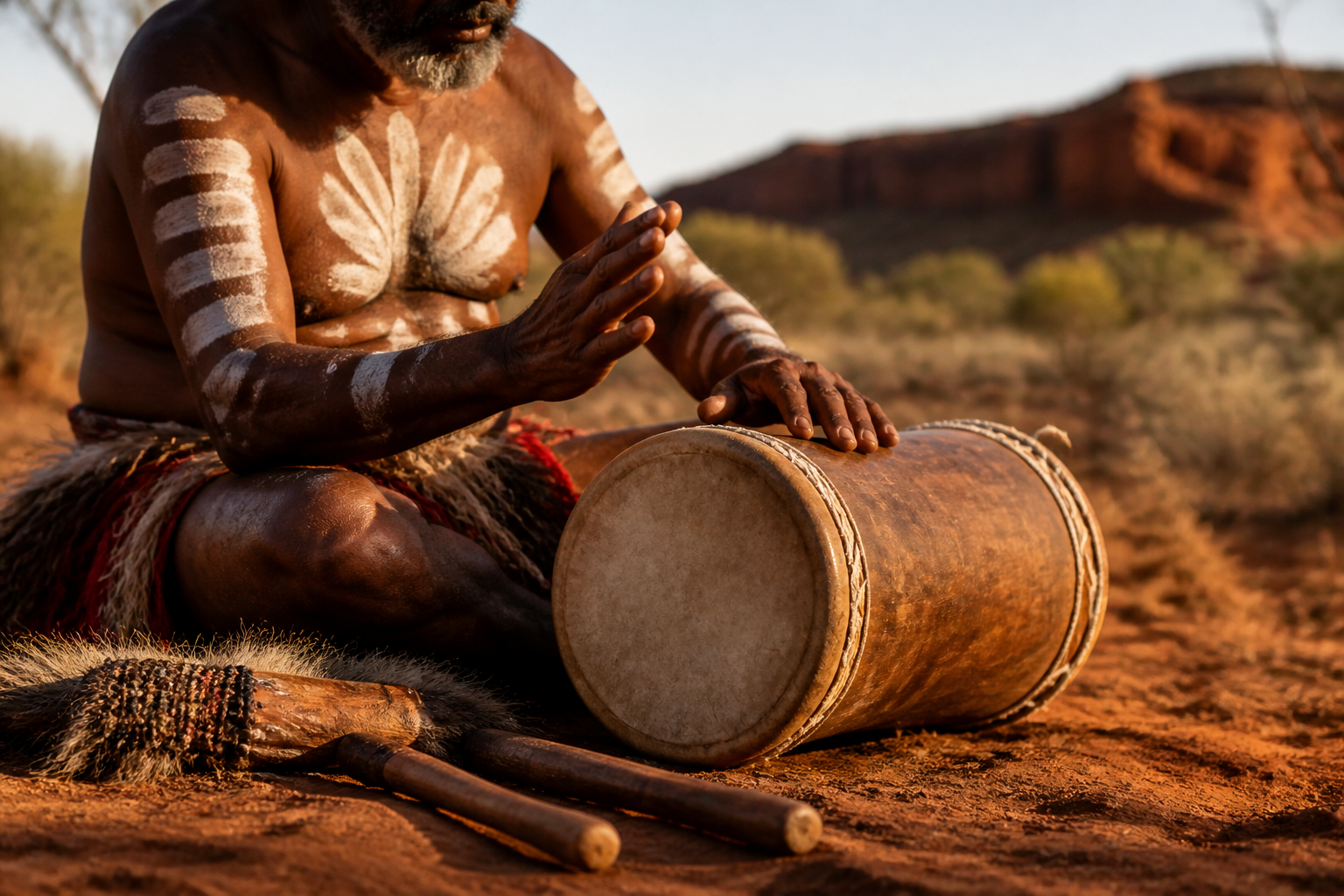
Where skin-headed drums are used, they are often made from a hollowed section of log or a carefully shaped wooden shell with goanna, kangaroo or other animal hide stretched across one or both ends. These drums are usually played by hand and may be held between the legs, laid across the lap or placed on the ground. The specific playing style is taught within families and is closely tied to local ceremony.
Mythic and Spiritual Significance
Aboriginal drums are embedded in the Dreaming, the ongoing spiritual framework that explains how the world was formed and how people should live. Stories describe ancestral beings who moved across the land, singing and stamping, leaving behind sacred sites and law. The beat of a drum or pair of clapsticks can recall those first movements, so that every performance becomes part of the same long story.
Because of this connection, many instruments are not simply tools. They are treated as cultural property with protocols around who may make, hold or play them. Some rhythms are considered men’s business, some women’s business, and some are reserved for initiation or mourning. Outsiders may hear only a beautiful pattern. For community members, that same pattern can signal a specific ancestor, a kinship obligation or a seasonal story that needs to be remembered.
In healing and spiritual work, drumming and clapping can help focus attention, regulate breath and bring a group into shared awareness. The regular beat supports trance-like states and deep listening, allowing participants to feel their own heartbeat aligning with the collective pulse. Elders sometimes describe this as a way of listening to Country with the whole body rather than the ears alone.
Contemporary Practice and Respectful Learning
Today, Aboriginal performers use drums and percussion in traditional ceremonies, in cultural education programs and on contemporary stages. Some artists combine ancestral rhythms with modern band instruments, while others keep ceremonial patterns within community contexts. The common thread is that the rhythm remains a carrier of identity and law, not just a musical effect.
For visitors and students of world music, it is important to approach Aboriginal drumming traditions with respect. That includes learning about the specific Nation or language group connected to a style, listening to community voices and being aware that some songs and rhythms are not meant to be copied or taught outside their home context. Supporting Aboriginal-led performances and educational projects is one of the most direct ways to engage responsibly.
The above article may contain affiliate links which help support Authentic Drums. However, it does not affect our editorial integrity. The content remains unbiased and authentic.